Communications is more than content, social media and storytelling
Narrative is just one piece of a much larger discipline

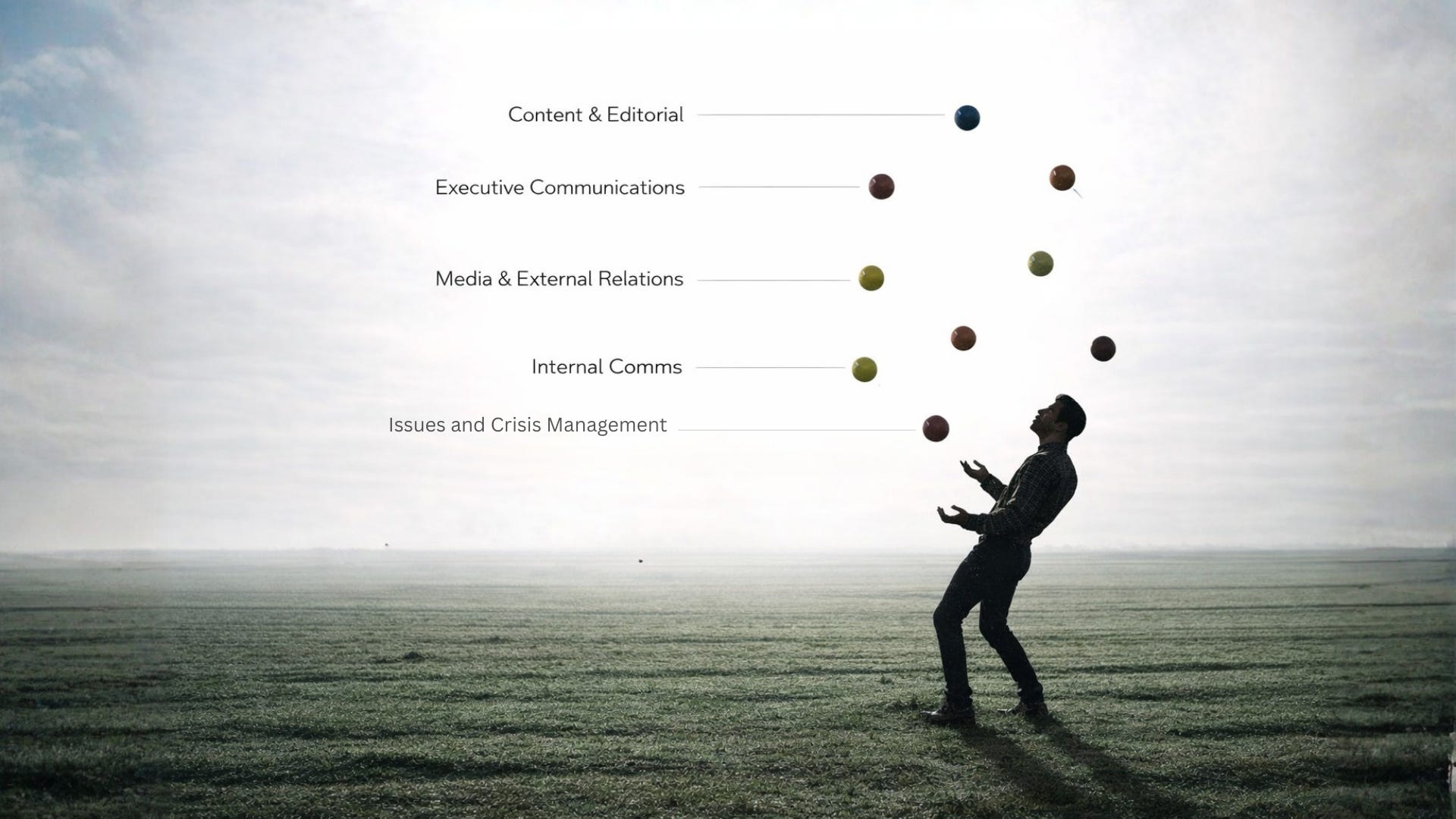
I once attended an interview where I was asked scenario-based questions on managing crises, shaping a corporate narrative, and advising leadership under pressure. The usual stuff.
For a few seconds, I was blank.
You see, I had never handled any of those scenarios.
Yes, I had run digital and offline campaigns. I had grown social media channels and even gone viral a few times.
But when the interviewer asked, “A regulator publicly challenges your organization at 9 a.m. Could you walk me through the next few hours of your reaction” I reached for common sense and fragments of things I had read online in my response but it did not click with the interviewers.
I ended up not getting the job but it was a wakeup moment for me. Beyond my knowledge gap, what that interview exposed was also a career hazard. I had over-indexed on a narrow slice of communications functions and mistook it for the whole discipline.
I’ve seen many people also have this similar experience. When many early comms people say they “work in comms,” they often mean one of two things: content or social media. While this is not wrong, it is incomplete.
Communications is not one job. It is a system of ten core functions that operate together (the number varies depending on the scholars you agree with). If you only build your career on one or two functions, it becomes harder to advance later.
My comms mental model
My friends know I’m a sucker for mental models. So here’s the one I use.
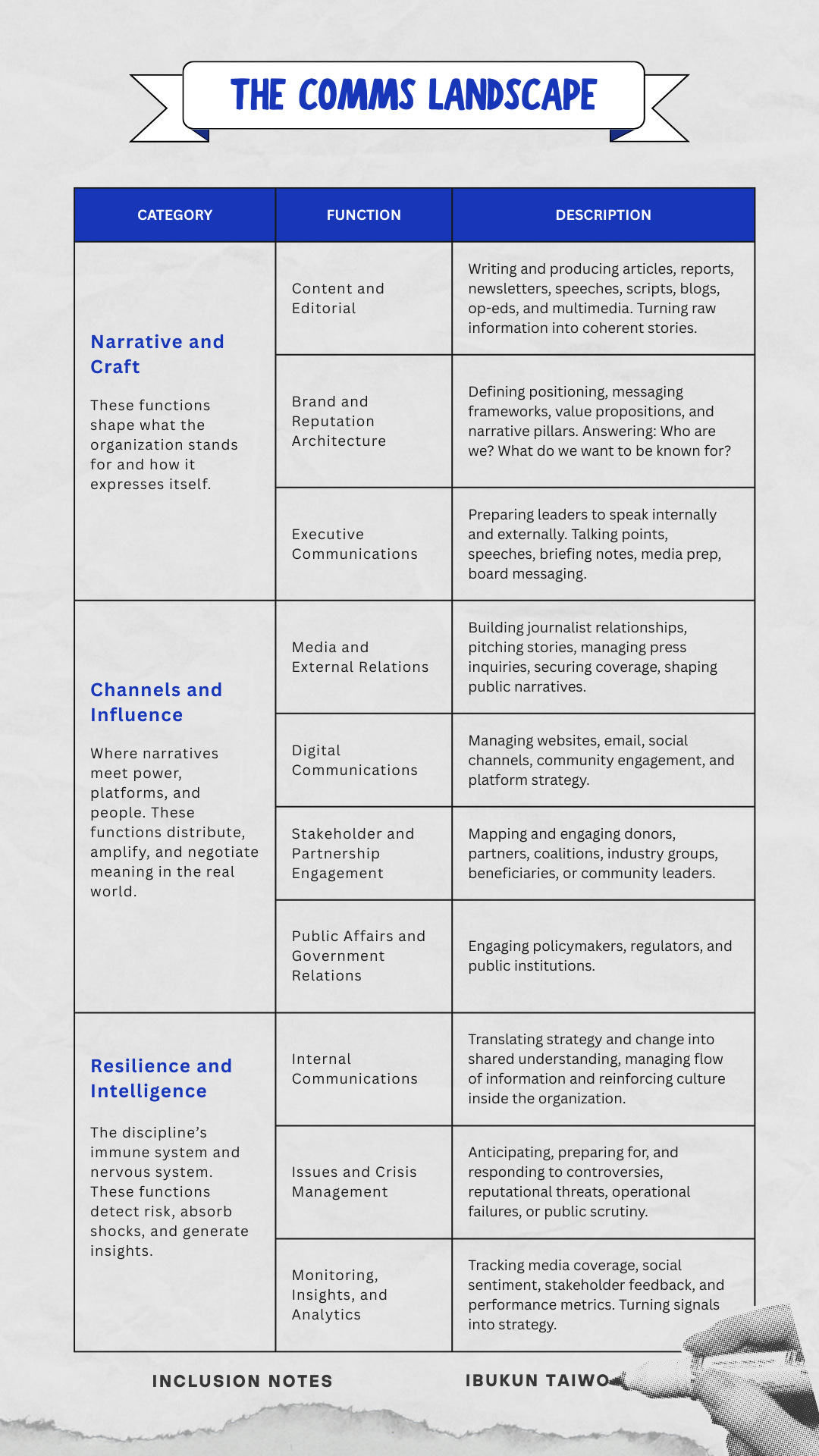
Think of communications as ten core functions organized into three buckets.
The buckets are memory aids while the ten functions are the real work.
Narrative and Craft is where ideas become language and language becomes meaning.
Channels and Influence is where narratives meet the world.
Resilience and Intelligence is the company’s early warning and “immune” system. It ensures durability.
As you can see, comms is broad. And as you grow in your career, your experience is supposed to expand across the 3 categories.
In many organisations, these functions overlap. In smaller teams, the same three or four people may handle nearly all of them. The point of this model is help you understand the lay of the land in comms.
Imagine growing up on a large island but living your entire life in one small corner and never leaving. Imagine one day, you are asked to become the mayor and lead the people. How prepared would you be if you had never left your own corner of the island?
Let’s take a few examples to see how these functions work together:
A multinational NGO is accused on a popular podcast of misusing donor funds. The allegation spreads across social media before the organization has even heard the episode.
Issues and Crisis Management is the leading function and they will decide: Is this credible? What is our exposure? Who should be the spokesperson? What do we say and when?
But the function cannot operate alone. Monitoring and Analytics must map how fast the narrative is spreading and where. Media Relations must prepare reactive statements and reach out to trusted journalists. Internal Comms must brief staff before they read about it on X. Executive communications must prepare the CEO for a possible live interview.

Let’s consider another scenario - a climate research institute has produced a dense 120 page technical report. It wants policymakers to act on it within six months.
Here, Public Affairs will take the lead. Someone must translate research into policy asks, map decision-makers, and design engagement moments. But they also need help from the people in Narrative and Craft.
Content and Editorial must distill 120 pages into a four-page brief and a one-paragraph framing line that will be used by a committee. Executive Communications must equip the director with language that resonates in private meetings. Digital channels must support the push with targeted amplification.
For a third scenario, let’s consider a company undergoing restructuring and rumors are circulating among staff. Morale and productivity are dipping.
The function to lead on this is Internal Communications. Employees need clarity before they need inspiration. But Internal Comms depends on Brand and Reputation, because the internal story must align with the external one. It depends on Monitoring, because pulse surveys and sentiment analysis will indicate whether messages are resonating with staff. It depends on Executive Communications, because leaders must show up in credible ways.
From these examples, you can see that no serious communications challenge is solved by one function alone. Each usually has a lead but also requires support.
If your experience is limited to only one or two functions, it becomes harder to lead comms effectively. Like the saying goes, a man with a hammer will consider every problem a nail. And this is the career risk.
We all start at the bottom floor, and our tasks are usually content production or social media management. These functions are visible and measurable because they produce outputs consistently. Crisis may not appear for years. Public affairs may sit with another team like Partnerships. Monitoring may be outsourced.
Five years later, you are now a mid-career or senior comms professional but no experience with high-stakes moments. In job interviews, scenario questions reveal the gap.
The solution is deliberate range building. That is, you must go out of your way to experience all the buckets and functions.
At the entry level, that could mean asking to sit in on a crisis debrief even if you are not on the core team. It could mean shadowing a stakeholder mapping session. The mental model helps you review the functions you have limited experience with.
For mid-career professionals, it means rotating your exposure. If you lead digital, can you co-lead a media strategy for one campaign? If you manage content, can you partner with the public affairs team for one legislative push? Yes you still have to do the job your line manager cares about in the short term, but you should never abandon long term thinking for short term results.
Expand your circle.
AI, used well, can support this range building. Use it to simulate crisis scenarios and have personal dry runs. Ask it to simulate hostile journalists, skeptical board members, or regulatory reviewers. Ask it to pressure test your responses. When you think you’re ready, let it generate mock interview questions that test your readiness across the 10 functions.
Whatever function you’re currently in, using AI will make you produce faster. But please do not use AI to narrow yourself further. Communications is not content. It is a system of functions that manage influence and risk across an organization.
If you are in your first three years, do not aim for mastery of one function. Aim for exposure across the 3 buckets. Pick one of the ten functions you have never worked on and design a small project around it in the next six months.
If you are mid-career, map your last two years of work against the three buckets. If one bucket is empty, correct it.
Senior leaders have a lot of responsibility here as well. Please help early career professionals understand the lay of the land early, rather than constraining them to one or two functions.
Again, communications is not content. It is not social media. It is not media relations. And while there’s currently a lot of excitement about “storytellers”, comms is also more than good storytelling.
Comms is a system of ten functions operating across Narrative & Craft, Channels & Influence, and Resilience & Intelligence.
Remember that.
Interesting reads
Being mid is the worst thing you can be
Really great article on positioning. Being mid gets you ignored, while the extreme, distinctive, or memorable get amplified. For creatives and comms people working on strategy, this is important reading. Joe links economics, platform dynamics, and brand strategy into one clear idea: being average is now a liability. Stop trying to appeal to everyone and become unmistakably “the most” at something specific.
If you enjoyed reading this newsletter, please like the post and share with your network. Inclusion Notes keeps growing every week and it’s due to people sharing it with their friends and colleagues.
Thank you for sharing this. I have found this extremely helpful. I work with a private NGO, and the comms department consists of my senior and me. I have been working with the department for over 2.5 years now, and I am at a point where I feel stagnant. As is usually the case, the department has been limited, and although we run many programmes, resources and funding are limited, so burnout comes easily.
I've come to realise I need to learn and read widely because I do want a career in communications long-term. I stumbled upon your profile on LinkedIn and look forward to learning more from you. I will especially look into creating small projects in the different functions. Would you recommend that I take courses or go back to school to expand my knowledge? Or continue to learn on the job?
This is great, thought provoking insight. I find it really relatable - not specifically from the crisis comms perspective, but from having the same realisation that, as Head of Comms, I’m not adequately across the full comms function.
My weak point, and the reason I joined Substack, is Media & External Relations. There’s an increased need for this now that the company I work for has diversified, and I’ve realised quickly that it’s a weak point for me. I’m using Substack to quickly try and up my knowledge and be successful in great and meaningful press work! I’m blogging the journey, in case you’re interested in joining me on it!